 Daily Nib
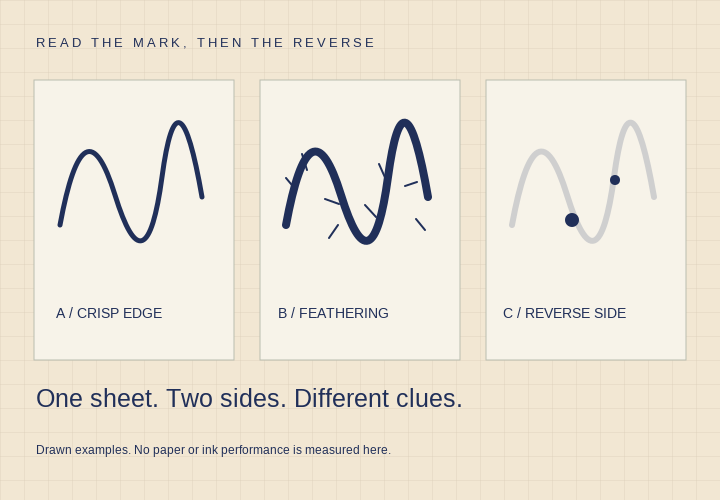
Before changing pens, keep a sample of the paper that gives you trouble. A notebook recommendation cannot tell you how your own pen and ink will behave on a meeting handout.
Make a small comparison you can repeat
This is our proposed observation method, not a completed product test. Take your usual paper and one alternative. Use the same pen, the same ink and the same sentence on each. Write at your normal pace. Add a few loops, a small block of text and a filled square. Date each sheet and write the exact pen, nib marking, ink and paper name at the top.
Let one sample dry untouched. On separate lines, make a light smear check at intervals you choose in advance; record those intervals. Use a clean scrap of paper for each check. The result belongs to that combination and those conditions. It is not a universal drying time for the ink.
Look for three different clues
These distinctions follow the terminology in Brian Goulet’s own writing demonstration, published 17 August 2023. Goulet is a retailer; we use the lesson to explain the marks, not to adopt its product recommendations.
- Feathering
- Fine branches around a line’s edge. Inspect the front of the sheet closely.
- Show-through
- The writing is visible through the paper. Compare an unwritten area and view the sheet against a plain backing.
- Bleed-through
- Ink has reached the reverse. Look for actual ink marks on the back, separately from a faint silhouette of the writing.
Choose the outcome that matters to you
For meeting notes, record whether you can close the notebook when you need to. For a journal, try writing on both sides and judge whether the reverse distracts you. For a letter, compare readability after the sheet has dried. Give each sample a plain observation—“smears when I turn the page” is more useful than an unexplained score.
Change one part of the setup next. A different sheet is a useful first comparison because it leaves the pen and ink fixed. If you change all three at once, you may find a setup you like, but you will not know which change helped.
Keep the experiment honest
Our diagrams explain what to look for; they are drawn examples. Daily Nib has no measured paper rankings or verified pen–ink–paper performance matrix yet. Keep your actual sheets with your notes and repeat the comparison before treating a single result as a pattern.
For nib selection, LAMY’s own advice is to try a pen against your handwriting. That is the source-backed principle behind checking a real writing sample; the comparison procedure above is our editorial method.
Make a desk check plan →